Kay's Picks

    ↓ WHY I USE iHerb ↓


    Wonderful Readers!

    NETWORK READERS

Showing posts with label shelter. Show all posts

Tuesday, January 11, 2011

DEBRIS HUT BASICS

Bookmark and Share
A debris hut is a structure constructed of found materials that can include leaf matter, branches, grasses and even snow. The insulated walls shield a person from cold and weather, serving as a combination sleeping bag and shelter. Using natural resources, a debris hut can be assembled in nearly any location. These can be used as an emergency shelter or a temporary shelter while you work to secure a more permanent structure.

While advanced skills are not required, experience and a good work ethic can be invaluable. A good training exercise is to construct a model from small sticks to get a good idea of what will be required for a full scale shelter. Another good idea is to build a full sized model using a time limit. In a survival situation, you may be limited by how much daylight is left in your day. Having a time limit will help you prioritize and work efficiently. Spending the night in your creation will quickly tell you which elements were lacking such as location, size, insulation, waterproofing, door construction, or bedding.
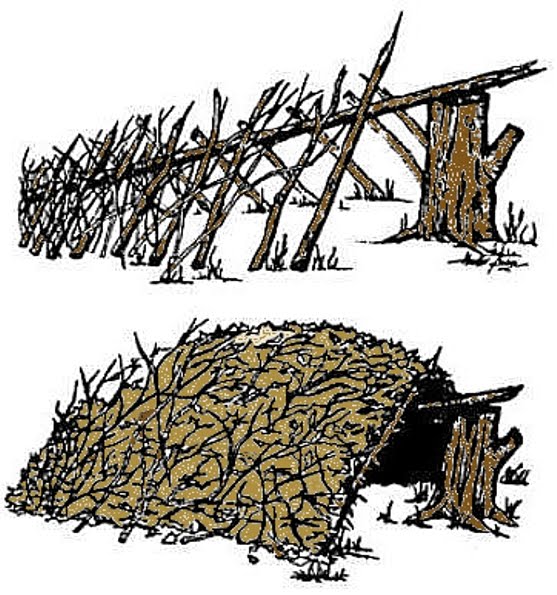
When deciding where to locate your debris hut, it is best to select an area that is a safe distance away from water sources. These could flood or dampen your shelter. Check the wind direction and position the entrance away from the prevailing wind. An open area that receives optimum sunlight surrounded by a stand of trees acting as a wind break is ideal. Keep the entrance small to help retain heat. A small fire at the entrance of your shelter will help keep you dry and warm.

When constructing a debris hut, smaller is better. This saves on construction time, materials needed and the smaller space is easier for you to warm with only body heat. Make it large enough for you to wiggle into feet first. To size the structure, lie on the ground and mark the outline of your body.

It is good to gather more material than you think you will need as the walls should be as thick as your arm’s length. Straight tree branches with leaves removed can be pounded into the ground to form your basic frame. A common method is to construct an A-frame for the entrance. This can be lashed together to form a support for the ridge pole and additional branches can be propped against the ridge pole to form the ribbing of the frame. On top of this, the debris is piled and woven to insulate and waterproof the shelter. If you have some thick plastic sheeting, use it to help waterproof your hut.

Every survival circumstance has unpredictable variables. Within these variables the human body needs to be protected from a loss of warmth that can lead to death. Knowing how to make a debris hut can truly be a lifesaver. Make a game of it and see what sort of structure you are able to construct from the things you find in your own backyard. Take the time to visit a wilderness area near your home and practice working as a group to build a structure. Once you’ve slept in your creation, you will know if there are things that need to be reworked. These fun activities can give you invaluable experience in the event of an emergency.


Dave Canterbury demonstrates how to construct a type of debris hut called a spider shelter in this short video.


The Wendell family demonstrates how a woman was able to construct her own debris shelter and overnight comfortably with her children in the structure.


read more “DEBRIS HUT BASICS”

Thursday, December 9, 2010

GUIDELINES FOR VOLCANO SAFETY

Bookmark and Share
It is best for people that live near a volcano to make plans for an eruption. Learn the alert levels issued by your local emergency management office and know what they mean. Listen for emergency updates and instructions, making note of information about hazards you may encounter. Prepare for a possible evacuation. Make additional preparations to shelter in place.

A volcanic eruption can alter the landscape in ways that are difficult to imagine. Near the site, there can be loss of life, and destruction of structures and property. The resulting ash cloud can cause airports to shut down and turn daylight to darkness. Earthquakes, flash floods, wildfires, thunderstorms and tsunamis can all occur as the result of a volcanic eruption.

Memorize the recommended evacuation routes. Maps marked with this route should be kept in each car and another in your home. Select maps with detailed geographical markings of the area surrounding your location. In the United States, hazard zone maps can be secured from the U.S. Geological Survey that will show probable lava flow paths and give time estimates on travel to certain locations along with their relative safety.

Prepare a getaway kit. Include safety goggles and dust masks or bandannas to protect your eyes and lungs from falling ash. Include long sleeved shirts, long pants and sturdy footwear. Keep a well-stocked first aid kit, blankets and warm clothing in a convenient location. With this, keep a battery-powered radio and fresh batteries so that you can still monitor alerts if your power goes out.

Unless you need to evacuate, stay indoors. Bring pets inside and move livestock into shelters. Close all vents, doors and windows for protection from ash and burning cinders. Put damp towels under doorways. Cover downspouts, machinery, electronic devices and computers to protect them from ash that can disable and clog machinery and pipes.

Listen for creaking noises from your roof. Ash will fall silently and can cause the roof to collapse under its weight. Remember to wear a mask and goggles if you go outside to clear ash off of the roof and gutters. Remove your clothing before re-entering the house rather than bring ash inside where it can irritate the airways of everyone indoors.

Keep at least three days worth of water and food in your home. An eruption can contaminate water supplies and you may have to rely upon what you have stored. If you hear that an eruption is imminent, fill all sinks, tubs and containers with water. Rely upon your stored water until your regular source is deemed safe.

If you must drive, use your headlights, proceed slowly at about 35 mph and watch your gauges for signs of an overheating engine. Ash can clog your radiator and other moving parts of an engine. Ash will also make roads slippery. When parked, cover your vehicle with a tarp and place it under a shelter to protect it from the falling ash.

If you must evacuate, turn electricity and gas off at the mains before you leave. Head for higher ground and try to stay upwind so that ash and gases are blown away from you. Volcanoes’ greatest dangers (lava flows, mudflows, poison gases and flooding) all move towards low-lying areas. An elevated area gives you greater protection than any attempt to outdistance the danger.

Afterwards, don’t return home until authorities say it’s safe to re-enter the area. Seek medical treatment for any injuries. The wait for medical treatment will be shorter for those farther away from the disaster site. When cleaning up property after an eruption, dampen the ash before sweeping or shoveling the buildup. This keeps the slippery substance from getting tossed back into the air.

Remember, in the event of an eruption, you may have only moments to react. Being prepared to move quickly and decisively can mean the difference between life and death.


This 4 minute video shows the extent of the destruction
caused by the eruption of Mount St. Helens.


This 17 second video shows Mount St. Helens
erupting in slow motion.

The entire side of the mountain slides to one side.

read more “GUIDELINES FOR VOLCANO SAFETY”

Wednesday, November 10, 2010

DVD REVIEW: "NAKED INTO THE WILDERNESS"

Bookmark and Share
Readers may be interested in seeing an example of how rustic skills can serve you. NAKED INTO THE WILDERNESS gives a good overview of how this is possible. It’s one thing to know how to start a fire or build a shelter, it’s quite another to know how to have a shelter, fire and food without ready-made tools. There’s another level of skill required to know how to utilize the strengths of each individual within a group, take advantage of found materials and manage the variables that weather and terrain can toss your way.

NAKED INTO THE WILDERNESS is a video that demonstrates how primitive skills can be applied in their context. To emphasize the value of each technique, the participants venture into a remote location without iron tools or containers.

Part one takes you into the Kansas woods as you observe skills in several categories. Watch as the individual participants form into a cohesive group, securing food, shelter and the tools they need to accomplish each task.

While stone tools make for a slower work pace, you'll see that a LOT can be accomplished with very few basic materials. Watching this gave me a real appreciation for some skills that modern culture seems to have left behind including:
● basket making
● pottery
● fire-starting
● cooking over an open fire,
● stone knapping to make knives, axes and arrowheads
● cordage
● shelter construction
● foraging
● trapping
● and more

The second part of the video shows another group camp that utilized modern bedrolls and pre-made primitive gear. This footage has some scenes that show how "down time" is used by members of the group to make improvements to the camp. Additionally, there are scenes that show some lighthearted moments. Day 4 contains some silliness as a couple of the guys decide to try swimming in frigid waters. If you'd prefer to pass on some back nudity, skip that section.

The DVD is divided into topical chapter headings so that you will be able to review applicable sections. If you are practicing individual skills, it helps to see them demonstrated in a real life setting -- although this is not a detailed instructional video. You'll also get a pretty good idea of how to prioritize tasks and divide the labor among individuals. NAKED INTO THE WILDERNESS leaves you with an appreciation for how a small tribe or community with few materials and some knowledge can greatly enhance the life of all its members when they are willing to work together.

This is a valuable addition to your library and will work well as a gift if you are interested in these skills for personal use or for demonstration purposes. The production value is not up to the polished standards of a professionally produced work. This is not a video on how to be rescued when lost. Rather, you’ll be invited to enjoy the home movies of experts in primitive skills and gain from their insights. In spite of surface noise distractions, dead air and the occasional “is that thing on?”, there’s a lot to glean from this footage. NAKED INTO THE WILDERNESS takes you from theory to implementation of skills you’ll need to survive in primitive conditions.


Available at Bulk Herb Store.
Click on the image to order.

read more “DVD REVIEW: "NAKED INTO THE WILDERNESS"”

Saturday, January 16, 2010

EARTHQUAKE SAFETY

Bookmark and Share
When the earth begins to move seconds are crucial. There isn’t time to panic AND survive. Choose to act and live. If you can feel a tremor, you are close enough to the epicenter (or blast) for there to be structural damage in your area. Depending on where you are located, the following guidelines may help save your life.

BASIC RULES
Keep a flashlight and sturdy shoes within reach of your bed and your work place. At home, keep clothing you can quickly put on within reach of your bed. If you are in bed when the shaking starts, remain in bed until the tremor is over. Once the shaking stops, put on your shoes and clothing. Broken glass will easily slice through bare feet (or casual/dress shoes) and hinder your efforts to get to safety.


DUCK * COVER * HOLD

IF YOU ARE INDOORS crouch near an interior, load bearing wall. Place yourself beneath a study object (table, etc.). Protect your head and neck with your hands. Brace yourself by hanging onto whatever you are beneath.

IF YOU ARE IN A TALL BUILDING duck under a sturdy object. Cover your head and neck with a hand. Hold onto whatever you are ducking underneath for stability. When exiting, always use the stairwells. NEVER use elevators during earthquake or fire.

IF YOUR ARE OUTDOORS
Observe where the large trees and power lines are located. These could be falling hazards. Avoid these or any other overhead hazards. Look for an open space where you can avoid falling debris. In the city you should avoid standing near high buildings. As much as 2 to 13 feet of glass could cover city streets below high rise buildings.

IF YOU ARE IN YOUR CAR
Stay in your car. Try to position yourself away from overhead hazards. Don’t park underneath an overhang. If you ARE stuck under a bridge in your car, remain in the car during a tremor. Tires will act as a cushioning (and insulation) if heavy debris fall onto your automobile. If you are on an open roadway, pull over to the side of the road (don’t block the road). Wait for the shaking to stop. Listen to your radio for reports & instructions.

AFTER THE SHAKING STOPS
Expect aftershocks; be prepared to repeat the DUCK, COVER & HOLD. Make sure you are okay. Get a flashlight. Flashlights are much safer than candles in the event of gas leaks. Account for everyone in the household (if at home). Get everyone out to safe place – pre-determined meeting place. Then, take a lap around the house to assess the damage to property – any large cracks, foundation movement, does the house look askew?

Don’t turn off natural gas until instructed by authorities. Listen to AM radio for updates/news from the Emergency Broadcast Network regarding where to go for help.

Don’t forget to locate your pets. Try to calm and re-assure them. Place them on a leash or restraint for several hours until you are SURE they are calm and not prone to running away. This can also help keep them from biting because of anxiety.

FOLLOW YOUR INSTINCTS
Use your best instincts regarding disaster safety. Observe the habits of nature around you. Did you know that on Monday, May 5th of 2008, frogs in China began a mass migration that took them across streets and roads? The following Monday, May 12th, central China was rocked by a 7.8-magnitude quake which killed nearly 10,000 people.


USE CAUTION
This article should be used as a guideline. Taking the time to think through your options BEFORE such an event will greatly help you should you ever find yourself in such a position. This information is not a substitute for professional services. The reader assumes all liability when utilizing these measures.
read more “EARTHQUAKE SAFETY”

Monday, January 4, 2010

HERBS AS INCENSE

Bookmark and Share
In the past, certain herbs such as sage and rosemary were burned to cleanse sick rooms. Cedar is a fragrant wood known to have antiviral, antifungal, expectorant, and lymphatic cleansing properties. Pine, Spruce and Fir needles contain shikimic acid, the main ingredient in Tamiflu, which is used to fight the bird flu. Frankincense is also a known to be very effective incense in the treatment of respiratory ailments. Mullein and Eucalyptus leaves are also beneficial herbs that can be used in this manner.

By slowly burning herbs, the essential oils are released into the smoke and carried into the lungs of those that inhale it. If a person is suffering from bronchial inflammation, the beneficial properties of the herb are applied directly to the inflamed tissue.

I know of one woman that had been dealing with such a strong cytokine response during a bout with the flu that she was choking, vomiting and struggling for air. Her husband closed the damper on their wood stove and tossed some Cedar into the fire, filling the house with smoke. Immediately, the cytokine storm stopped. Within 20 minutes, there was no mucus and she felt as though she hadn’t had the flu at all. They have repeated this remedy with the same result on other family members, airing the house afterwards.

American Indian tribes regularly used Cedar to smoke and cleanse their homes. In rustic conditions, smoke can be used to cleanse a person, clothing, bedding or shelter of vermin, molds, etc. Cedar smoke was one of the ways that priests were instructed to cleanse a house where there had been a plague (cf. end of chapter 14 of Leviticus).

HOW TO BURN HERBS AS INCENSE
Using tongs, place a hot coal or ember from a hard wood fire onto a heatproof dish. Place the herbs onto the hot coal and allow the herbs to smolder. Inhale the resulting smoke. The goal is to encourage the plant material to produce smoke, not to ignite into an open flame. This can be accomplished by only using hot coals (rather than fire) and/or by binding the plant material into a tight bundle.

Tightly bundled herbs are called smudge sticks. Some branches, twigs or leaves are supple enough to form into tight braids. Dried leaves can be secured with twine and unbleached paper. To use a smudge stick, hold one end of it to a flame until it ignites. Then the flame is gently blown out leaving the plant material to smolder and smoke. Smudge sticks are handy as it is easy to direct the smoke and they will tend to burn for a longer period of time.


CAUTION
Do not inhale the smoke of any herb or plant material to which you have known allergies. This article is for information purposes only. Readers that incorporate these methods do so at their own risk and should utilize safety precautions. None of this information is a substitute for professional health care.
read more “HERBS AS INCENSE”

Thursday, July 16, 2009

SUSTAINING LIFE IN A CAVE

Bookmark and Share
Norman’s Ranch and Sportswear Store can be found in a little town called Havre, Montana. Norman’s is a thriving enterprise, but that’s not all there is to see in Havre. Beyond the rail museum and other highlights you will find ‘Beneath the Streets.’ Today, this is a novel stop on a tour, but at one time it was a bustling business zone. One hundred years ago, cowboys and ranch workers would find their way here to be relieved of their pay by gambling, drinking, visiting the opium den and keeping company with enterprising females.

Havre might have been one of the early pioneers of below-ground businesses but it wasn’t the last town to try it. Craighead Caverns is part of a massive system of caves in a place called Sweetwater, Tennessee. About 70 years ago, Fort Oglethorpe utilized horses. The manure from those horses was used as fertilizer for a mushroom farm begun in a large cavern. Those mushroom beds were located near a dance floor that became a nightclub called the Cavern Tavern.

Caves aren’t normally sought after as permanent shelter, but it’s not really a bizarre idea. This has been tried previously. The real sticking point is to try and conceive of how entire groups of people could be housed AND find a viable source of clean food, air and water within a cave for great lengths of time.

When studied, however, this may not be such a strange idea.

About 40 years ago, Soviet scientists were testing several types of algae to determine their nutrient content. Techniques perfected during that research are being used today to create nutritional supplements. Because it is necessary to secure a large climate-controlled growing environment, some manufacturers are utilizing caves. Systems are being marketed today which grow fish and vegetables using limited resources. This is accomplished by using water filtered from the fish container to feed nutrients to the plants which are grown in trays with peat moss and pea gravel. Along with automated feeding, both the fish and the plants receive artificial sunlight via solar powered growing lights. As you may have already surmised, it is possible to utilize this technology to create a livable environment inside a cave.

However, the idea that both humans and animals could live for extended periods inside of a cave without returning to the surface for supplies is not the only surprising revelation.

Rural Tennessee has produced a writer that has used these pieces of information to create a suspense-filled story in her newest book, The Vision. Near a labyrinth of caves reside Debi Pearl and her husband, Mike. Together, they serve as administrators of No Greater Joy Ministries. ~ There, they also oversee No Greater Joy Ministries. While Debi Pearl is well known for her writing, this is her first work of fiction. Debi’s newest work, The Vision is not unlike the caves of Tennessee; taking the reader around surprising twists and turns that raise questions about whether these things might actually occur.

The first in a series, The Vision delivers on its promise to both entertain and inform. Get your copy of The Vision by Debi Pearl today.
read more “SUSTAINING LIFE IN A CAVE”

Wednesday, July 8, 2009

PREDATORS PREY ON RUNAWAYS

Bookmark and Share
Survival skill training can be one way to help your child avoid becoming a victim. The ability to find food and shelter until rescued will shield a child from many dangers. One of the most important ways a parent can protect children from abusers is to work to provide a safe, secure home environment where a child knows he is loved and wanted.

Criminals know that runaways are easy prey; that’s why they target them. The Vision is a new book by Debi Pearl that touches on the reality of the victimization of runaways in this country.

Rates of runaways soar as more and more families are disintegrating. Over two and a half million children run away from home each year according to the United States Department of Justice. A large number of runaways are lured into illegal solicitation. A majority of these children are indentured into service by abusers. Many of these go unnoticed because their disappearance is never reported to authorities by their malfunctioning family.

Federal agents in a nationwide sweep broke up more than 12 child prostitution rings in October 2008 that used children as young as 13 up to age 17. Metropolitan areas were not the only places these businesses thrived. Many of these operations are able to thrive in areas that are suburban or rural.

Criminal hunters study the mental and emotional makeup of their targets. They realize that these children are in search of a secure and safe place. Whatever the child lacked at home – food, clothing, money, attention, shelter – all of that is promised by the abuser. The control of the children is additionally secured by physical force and the threat of violence.

The response of local law enforcement is often to give a criminal record to these children. While a child must be 17 in most states in order to qualify as a consenting adult, there is no age limit on how young a child must be to escape prostitution charges. While the law states that an underage child cannot consentually agree to intercourse, those same laws can be used to level criminal charges against a child engaged in that activity.

Hundreds Nabbed in Prostitution Bust
Shared via AddThis

These youngsters lack family members that are willing to take them in, or rather, no family with whom they would want to live. It is not common to find safe houses with counseling services, medical treatment, and crisis management. Although released from jail or juvenile services, these children often have no other option but to return to the same bondage they escaped.

The Vision contains a story of several people that encounter a hopeless, young runaway. Endurance, faith and patience are put to the test as an angry, untrusting soul is at stake. This is just one of the strands that is woven into the tapestry of The Vision. Find out what happens! Don’t wait to purchase your copy of The Vision by Debi Pearl.
read more “PREDATORS PREY ON RUNAWAYS”

Wednesday, June 10, 2009

RULE OF 3'S TO SURVIVE

Bookmark and Share
The number 3 can be the key to your survival in an emergency. When you must prioritize your needs quickly, it helps to know what is most urgent. Knowing the rules of 3 can give you the information you need to make smart decisions.


http://www.free-camping-recipes.com/wilderness-survival.html

"It seems pretty obvious what your priorities should be in a wilderness survival situation once it is spelled out like this. However a lot of beginners think that finding food is the first thing they should do. So they spend all of their energy trying to find some berries, and before they know it the sun is setting. It's getting cold. Clouds are rolling in, and it starts raining. They still have no food, and now they don't have any shelter. That is not a situation we would want to be in. How 'bout you?"


YOU CAN ONLY SURVIVE . . .

3 SECONDS without hope
Most individuals freeze in an emergency. In the immediate confusion and chaos, the human brain tries to draw upon some familiar experience for a plan of action. Finding none, we become immobile. You have three seconds to decide that you have hope and move forward. Statistics show that in a plane crash, you have 90 seconds to exit the wreckage. Three seconds without hope can make the difference between whether or not you have time to clear the area.

Survival depends upon your ability to shake yourself out of the stupor of disbelief and hopelessness.

Walter B. Cannon studied the case histories of sudden, unexplained deaths from around the world. In 1942, he published his theory that the brain unleashes stress hormones that can cause fatal heart arrhythmias in individuals that have given up all hope of escape -- they are literally scared to death. Use fear to spur yourself towards life-saving action. Determine to grasp onto hope and make a plan to live.

3 MINUTES without air
Few people can hold their breath for 3 minutes. In circumstances where oxygen is limited, your next priority is to get to a place where you can breathe.


3 HOURS without shelter (in extreme conditions)
Once you have breathable air, your next priority is to find (or construct) shelter. Those who take off on prolonged hikes may find themselves going in circles and/or racing the setting sun to construct safe sleeping quarters. In extreme conditions, you can live for a couple of days without water and weeks without food, but you cannot survive without shelter. You could suffer from hypothermia at 50 degrees, especially if the wind is blowing and you are wet. In warm climates, you will need shelter from the sun. Protect yourself from the elements.

3 DAYS without water
The next challenge is to find clean water. This may mean collecting rainwater or finding a water source shared by plants and animals. Avoid activity that leads to lots of sweating and heavy breathing. This causes your body to lose water more quickly. Conserve what water your body has by working at a nice steady pace. Whatever your course of action, your body will need water soon.


3 WEEKS without food
Some of us will survive even longer without it, but food will become an urgent concern for survival after a couple of weeks. With plenty of water, some can even survive longer than three weeks, but you will want to locate a source of nourishment while you still have the strength to do so.


3 MONTHS without companionship or love
This is actually part of the first rule of 3. In order to continue in a prolonged survival circumstance, most people need to have a sense of purpose and belonging. Knowing that someone is there for you and caring what happens to you can help you continue doing what is necessary for survival when the days and weeks seem to drag. Strong faith will make all of the difference for these survivors.


This video offers important information on adaptability and a survival mentality by David Wendell.


FOR FURTHER READING:
The Survivors Club by Ben Sherwood (ISBN-10: 0446580244)
http://www.free-camping-recipes.com/wilderness-survival.html
http://www.mountainsurvival.com/
read more “RULE OF 3'S TO SURVIVE”

Tuesday, May 5, 2009

ALTERNATIVE BUILDING MATERIALS AND METHODS

Bookmark and Share
LABOR SAVING DEVICE
A mixer is an expensive piece of equipment that will make home building less labor intensive. Whether you are using concrete, papercrete, adobe, or cob, a mixer will help the task move along much more quickly. If you are at all mechanically inclined, you may be able to find a used one and refurbish it for your own use. If not, consider making your own homemade mixer.

To make a homemade mixer you will need:
(Image courtesy: http://www.starship-enterprises.net/Papercrete/Mixer/)
* A large, galvanized tub (feed tank) mounted on a tow trailer.
* Lawn mower blade attached to the tow trailer's axle differential.

Pull the trailer behind your truck (or mule, or whatever). The movement of the axle spins the lawn mower blade and mixes your mix.

You can see an example of this mixer being used in the video that follows.

PAPERCRETE is one of several materials that can be used to create your own shelter.
YOU WILL NEED:
  • 30 pounds of concrete
  • 18 pounds joint compound
  • 1 pound boric acid (to make your home bug-proof)
  • 90 pounds recycled newspaper and/or cardboard (wet and shredded)


PAPER ADOBE is much the same as papercrete, only no concrete is used in the mixture.
  • 45 pounds waste paper
  • 120 gallons water
  • 100 pounds of clay
  • 11 shovels of sand
ADOBE
http://www.firebudd.com/adobe/
http://en.wikipedia.org/wiki/Adobe

HOW TO MAKE ADOBE BRICKS (COB MATERIAL)


ADOBE RECIPE:
From the site: http://www.zetatalk.com/shelter/tshlt04c.htm
Time required: about one month (most of it waiting for bricks to dry).
Cost: little or nothing
Materials:
  • One five-gallon bucket
  • One mixing stick or old wooden spoon
  • 1/2 bucket of adobe clay
  • 1/4 bucket of sand
  • 1/8 bucket of straw cut into two-to-three-inch pieces
  • Enough water to make a doughlike consistency
  • Six empty half-gallon waxed milk containers OR six 4 * 11 * 22 inch wooden brick molds, which can be made from 2-by-4s nailed together
  • Waterproof tape
Directions:
  • Thoroughly mix the adobe clay, sand and straw in the bucket; add only enough water to create a workable consistency
  • You can use either the wooden brick molds or the waxed 1/2 gallon milk cartons. To make the molds from the latter, cut one side from the carton (which becomes the open top of the brick mold). Cut and flatten the folded spout end and tape the carton firmly into a rectangular shape.
  • Pack the brick mixture into the cartons, filling each about tow-thirds full. IN 15 minutes to 24 hours, the brick will be firm enough to tip out. Each batch is different' you will have to judge when your mix will maintain a brick shape.
  • Place shaped bricks in a sunny location and turn repeatedly as they dry. (A completely dry brick is uniform in color, inside and out.)
MOST EXCELLENT ARTICLE on building with Adobe by J.D. Hooker can be found here. Make Adobe Bricks. Illustrations are included and a description of how the bricks are stacked into a makeshift oven and hardened by firing.

HOW TO MAKE COB/ADOBE. This video shows how cob/adobe can be made without a mechanized mixer.


COB CONSTRUCTION
One of MANY recipes for making cob:
1 part clay
2 parts sand (this keeps the finished product from cracking)
Mix thoroughly
Add just enough water to make a firm dough. A hard packed ball should not shatter when dropped to the ground from shoulder height. If it shatters, it needs more clay. If it flattens (like a pancake) it's too wet.

At this point, the mixture could be used to build an outdoor oven.

TO BUILD STRUCTURES WITH COB, you will add straw (not hay, straw) to your mix. When the mud/sand mixture is the consistency of peanut butter, add your straw. Straw allows the mix to support more of its own weight when wet. It also allows you to make wetter mud, which is easier to sculpt.

Cob Cottage Company (includes lots of pictures of cob houses)
Cob Building in the Country
See this free book online:
Cob Builders Handbook

STRAW BALE CONSTRUCTION
http://www.balewatch.com/

STRAW BALE HOUSE MADE BY SINGLE MOM FOR $50,000


STRAW BALE CONSTRUCTION, DEBUNKING THE MYTHS OF STRAWBALE


HOUSE BUILT USING VARIOUS RECLAIMED MATERIALS (MOSTLY COB).


COB AND WOOD CONSTRUCTION COMBINATION (for roundhouse) . . . also shows example of Reciprocal Frame Roof.


EARTHBAG CONSTRUCTION
To search for more information on the internet regarding this system, use the term 'earthbag' rather than 'sandbag.' If you search for 'sandbag' you will find several helpful hints on how to make your own exercise equipment, rather than how to construct a building.

The speaker on this video has a heavy accent, but I believe it is worth watching more than once to catch what he is saying. He discusses the type of bags used, how to prepare the soil, using barbed wire as a type of mortar to hold the bags in place and how to build using the bags in a staggered pattern. Note: this video does not discuss using a 'tube' system, but separate bags.


RAMMED EARTH CONSTRUCTION
http://www.diyrammedearth.com/
This method is similar to earthbag building except that there are no bags. The earth is held in place by using wooden forms.


VIDEO: John Ryan -- fun Appalachian music background


RECIPROCAL FRAME ROOF:
This type of roof helps create rooms that appear larger because they are not broken up with interior support beams.

"The reciprocal frame is a roof structure where each beam both supports and is supported by other beams in the roof structure. A minimum of 3 beams is required to create a reciprocal frame roof. As each beam supports the next in a reciprocal manner no internal support structure is required. Only the outer end of each beam requires support which will normally be a post used for the wall. The roof loads are transferred to these posts and in turn to the supporting foundation. The beams can be fabricated from timbers, laminated wood, steel or reinforced concrete. A very inexpensive roof structure can be made from logs."

RECIPROCAL FRAME ROOF
Click on the above link for more information on Reciprocal Frame Roofs. Scan down the page and click on the image of the ceiling for details which include architectural drawings.

THERMAL MASS OF NATURAL MATERIALS:
http://www.adobebuilding.com/Adobe_Building_Manual.pdf
"Adobe brick has a high thermal mass meaning that when the brick heats up, it can hold a large amount of heat and then release it slowly. In a well-designed solar passive adobe brick home, the winter sun heats the adobe bricks during the day. This heat is held in the brick and released during the night, keeping your home warm. Conversely, sun is kept off the mud brick walls during summer with strategically placed eaves and/or a verandah, allowing them to stay cool during the day and remain cool all night."

"This time course of the heat transfer is also known as the “thermal lag”. Essentially, the thermal lag is the amount of time it takes for heat to 'pass through'. The thermal lag for earth walls is around 7 to 10 hours for a one-foot (300mm) thick wall. This is ideal for most climates as mid-day heat will be released after the nighttime drop in temperature."


SHIPPING CONTAINER HOUSES
Retired train cars, cargo shipping containers, and truck bed containers are also being utilized to create low-cost housing.

Converting Steel Shipping Containers to Housing


COMBINING METHODS FOR HYBRID BUILDINGS:
Here is an example of a New Mexico house created using several different alternative techniques.
"This segment gives a quick overview of some materials used in green building, including straw bale and adobe walls, earth plaster, natural materials, passive solar heating and cooling, and much more. "


WORTH A TRY:
Alternative building materials are an abundant resource in a society where excess items are routinely disposed. It is not likely that such alternative construction will make a great impact on the environment, but these utilizing these methods WILL save you money if you are inclined to utilize them. Established homeowners can save money by creatively utilizing these methods as they maintain and develop their current property. Cob construction (and similar) methods can be used to create outdoor ovens, walkways, walls, garden benches and many other pleasant features that will increase property value.

Additional Reading:

http://www.constructionbusinessowner.com/topics/environment-and-compliance/recycling-construction-materials-an-important-part-of-the-construction-process.html


http://www.smartgrowth.org/library/resident_const_waste.html

http://activerain.com/blogsview/392846/You-Could-Build-a-House-from-Recycled-Building-Materials

http://www.greenhomebuilding.com/index.htm


This blog presents ideas and information designed to enrich the life of the reader. These articles are NO substitute for consultation with skilled professionals. The opinions and ideas expressed are fallible and that of the author. Readers are encouraged to be well-informed and draw their own conclusions.


read more “ALTERNATIVE BUILDING MATERIALS AND METHODS”

Sunday, May 3, 2009

BUILD-IT-YOURSELF HOMEOWNER HELPS

Bookmark and Share
Building your own home is an option for people who own land, but lack the funds to have a ready home constructed.

BUILD BELOW THE RADAR
There are MANY MANY plans from many sources on how to build your own home. While recommendations vary on many points, one place where they all agree is that you must know what the building codes are in your area. You will want to know what must be done to the property to make it ready for a residence. Decide on your water source and sewage options and build in such a way that you have the option to make improvements later. In other words, hauling water is fine while you are young, but you will likely appreciate indoor plumbing in your later years. Construct your dwelling with these things in mind.

One of the most intriguing plans I've seen is that of compound building. Rather than build a single building for a dwelling. some homeowners are opting to erect several small storage shed sized buildings. These are often small enough that no building permits are required. They can be positioned much the same as rooms would be in a house, but they each have their own foundation and roof. A wall is erected around the outer perimeter to
secure the compound and sometimes a roof is placed over the interior courtyard with walkways between rooms (buildings).

This plan for a compound home is of one made with hay bale construction.
Illustration courtesy: http://www.balewatch.com/

If you are homesteading, many authors suggest that you live in an old trailer home (or shack) on the property while you are building. During this time, your tools will likely be kept under a tarp or other waterproof container. Your first construction project (building A) will be the building which will later become your storage/garage space. This will help you perfect your skills while gaining experience. Once building A is complete, you live in building A and use the old trailer for storage while you construct building B. As each new section is finished, you move possessions into that and equipment/tools into your finished storage (which you just vacated).

FREE BUILDING MATERIALS
If you more time than money, you can acquire many building materials for the cost of carrying it away. When modern construction methods are used, the excess materials must be cleared from the site. This is an expense to the contractor. If you follow the construction industry and are dependable, you may be able to get materials FREE in exchange for saving the contractor the expense of hiring a disposal service.

This site has a nice table on how materials can be used in construction:

Recycling Construction Materials: An Important Part of the Construction Process.


MaterialHow Is It Recycled?Recycling Markets
ConcreteThe material is crushed, the reinforcement bar is removed, and the material is screened for size.

  • Road base


  • General fill


  • Drainage media


  • Pavement aggregate

Asphalt PavementThe pavement is crushed and recycled back into asphalt, either in-place or at a hot-mix asphalt plant.


  • Aggregate for new asphalt hot mixes


  • Sub-base for paved road

Asphalt ShinglesAfter removal of nails, asphalt shingles are ground and recycled into hot-mix asphalt.

  • Asphalt binder and fine aggregate for hot mix asphalt

WoodClean, untreated wood can be re-milled, chipped or ground.


  • Feed stock for engineered particle board


  • Boiler fuel


  • Recovered lumber re-milled into flooring


  • Mulch and compost

  • Animal bedding


DrywallDrywall is typically ground or broken up, and the paper is removed.


  • Gypsum wallboard


  • Cement manufacture


  • Agriculture (land application)


MetalMelted down and reformed

  • Metal products

CardboardGround and used in new pulp stock

  • Paper products


FOUND MATERIALS CONSTRUCTION
The house in this video "was built over a period of seven months into the side of a hill. It was constructed almost entirely of salvaged, natural, second hand, or found materials. We wanted to see what could be accomplished with out buying newly manufactured materials..."


LARGE PROJECT HELPS
(Image courtesy of http://www.strawbaleconference.com/index.html)

Don't be afraid to ask for help. Building a dwelling can be labor intensive
(another reason for building small). You can gain experience in using
your method of choice by volunteering to help with an ongoing project
near your home. Search the internet for 'learning workshops.' If you are willing to travel and camp overnight, you will be rewarded with more learning opportunities.

When you have enough materials assembled, you can host your own workshop (well worth the expense of hiring an experienced facilitator to teach and organize the crews, in my opinion). Well-placed announcements on the internet and the local health food store (or farmer's market) will get the word out. Consider what you would want to have available as a volunteer, and secure those items when you host a work day(s). This would include toilet facilities, drinking water, possibly a camping area, and possibly enough food for a common meal. Your educational facilitator will likely have some ideas about what works well in these settings (and what he/she may require).

Next, we will look at alternative building materials and methods. . . .
read more “BUILD-IT-YOURSELF HOMEOWNER HELPS”

Friday, May 1, 2009

TRANSITIONAL & EMERGENCY SHELTER

Bookmark and Share
Various circumstances displace people. News footage often shows tent and cardboard villages which provide inadequate housing for refugee families. Overcrowded conditions and sub-standard shelter can contribute to the spread of disease and abuse.
Emergency shelter can include that provided by government agencies or that offered by generous friends or family members. These are not always an option. Creativity may be the key to finding protection from the elements.

URBAN SQUATTING (NOT RECOMMENDED)

Please understand that trespassing is a crime in most parts of the United States. The following is for emergency preparedness information only. Urban squatting is by it's very nature a risky proposition. It is not a romantic alternative lifestyle choice. For the purposes of this article, it is a means of surviving until you can get to a more secure location. Those who would vandalize property and take advantage of absent property owners in order to escape the expense of making adequate provision for themselves and their families are (according to my understanding) thieves and robbers.

This option may only be workable for one or two persons as transitional, not long-term, housing. In other countries, there are laws giving legal status to a person that enters a deserted building and takes up residence. This is not the case here in the U.S.

Having made those disclaimers, it is possible to find livable circumstances in urban areas while you seek to find more permanent housing. Deserted buildings abound, especially in tough economic times. It is illegal to break into a space which has been secured and/or posted. It is possible to find spaces that have not been posted or boarded up . . . but you enter at your own risk (some of these spaces are not structurally sound) and (depending on the laws in your area) with the understanding that you could be on the wrong side of the law. Look for a location that appears to be deserted. Be mindful that you aren't likely the only one looking for housing. There may be another squatter(s) there, and he/she/they may not welcome the company. Look beyond residential housing. Consider abandoned business properties that are otherwise sound.

In a circumstance such as this, good camping skills would come in handy. You will need to know how to dispose of your own garbage and waste in a way that does not promote disease or damage property. You may find it best to remove small bits of rubbish at a time to avoid drawing attention to yourself.

Don't make your presence known. Be discrete about your comings and goings and keep the noise level down. Privacy is your friend and should be guarded.

Consider spaces that weren't originally constructed as residences: alleyways, crawl spaces, space beneath bridges, under docks, etc.

Be quiet and do not be destructive. It costs nothing to clear away debris. Make any improvements you can. You may secure the property by replacing broken windows and repairing doors. You may even be able to make other simple repairs. If discovered, your efforts will go a long way towards convincing the owners of your intent to cause no harm. They might even be grateful that you kept the property in good condition, and law enforcement MIGHT decide they have better things to do than run you in (but don't count on it).

RENT IN TRADE:

If you are at all handy with tools, you may find that some property owners are happy to have you live there rent-free in exchange for some sweat equity. A person willing to do some hauling and cleaning could return a building to livable conditions that would otherwise be condemned and a liability. By scavenging for used materials (windows, doors, flooring, lumber, etc.), you can get supplies for little or no money (or in trade). If you have a truck, some tools and know how to shop for a bargain, such an arrangement (free rent for repairs/maintenance) could benefit all concerned. The owner's property is improved and kept from vandals. In addition to the free rent, you might be able to grow some of your own food.

If you aren't up to the task of landscaping a wilderness or rebuilding a shack, consider something smaller. You may find a nice neighborhood where someone wants to turn that unfinished attic room into an apartment. Transform a junky garage into a new den or perform routine home maintenance and repairs in exchange for living in the space. While this wouldn't work for people with families, single persons with skills (and excellent character references) could earn themselves a nice rent-free home for a stretch of time.
read more “TRANSITIONAL & EMERGENCY SHELTER”

Friday, February 20, 2009

Whatcha Need? Whatcha Got?

Bookmark and Share
To admit that we might go hungry without the benefit of a grocery store would seem ludicrous to many of our grandparents. Have you noticed that simple, creative solutions escape us when we accept the thinking that without "A," "B" cannot be done?

This point was driven home for me as I visited a village a few years ago. We stopped to watch a canoe being made. The artisan explained that no metals tools were needed for the task. Of course, with a chainsaw and some carving tools, the project could be finished in a day with the help of some skilled friends. The artisan admitted that this was true. Everyone nodded in agreement.

THEN this wise man noted that there were limits to such assembly line thinking. The team working with modern tools would be limited by their brute strength, speed and the number of hours in a day.

He went on to describe how that even children could fell a stand of trees and simultaneously produce a fleet of canoes within a matter of weeks (or days) -- all without modern tools. Even working around the clock, the team of strong men couldn't match that.

His methods were both simple and reproducible.

TO FELL A TREE:
* Locate a source of water and mud.
* Pack the mud around the tree on all sides -- about 6 feet high (or as high as you could reach) -- and leave an open space to expose the trunk on the downhill side of the tree.
* Build and tend a HOT fire at the open spot in the clay.
* Periodically, pull the fire away from the tree and scrape away the charred part of the tree.
* Repeat this process until the tree falls. Tend the flames carefully so that the tree does not catch fire. This can be done with more than one tree at a time if you are industrious. http://www.native-art-in-canada.com/fellatree.html

TO BUILD A CANOE:
* Place wet clay beneath and around the sides of the felled tree.
* Keep this moistened throughout the process.
* Chip away at the topside of the bark and create a flat surface.
* Build a fire along this topside of the tree and keep it smoldering.
* Several times a day move the coals off of the surface and scrape away the charred parts of the tree trunk.
* This can be done with clam shells, hard wood, or other homemade scraping tools.
* Repeat until the log is hollowed out, creating the canoe shape.

Once you have become experienced, several canoes could be made at the same time using any person old enough to know how to tend the fires -- enough to barter or trade for other goods/services. While the strong team of men with modern tools could produce a finished product faster, they could not match potential numbers produced by the less labor intensive method.

The point of this article is not to teach you the finer points of tree felling or canoe construction using alternative means. Rather, it is to encourage you to think outside the box. Instead of thinking "I cannot secure shelter, food, clothing without money to secure tools, cloth, lumber, or whatever," we may be better served by taking inventory of what we DO have and finding ways to utilize that. If you don't have the manpower for a large task, harness the power of the raw materials at your disposal -- water, fire, clay, sand, plants, animals, etc. -- and work efficiently rather than just intensively.

We may not be able to build a factory and mass produce identical products for wealthy consumers, but -- just as the natives without modern metal tools and a team of strong men -- we can find alternative ways to secure what we need.

If you have a skill that you enjoy, make yourself valuable to others and trade your time for the items you lack. You might need a cabinet. The local carpenter might benefit from the wild grapes you harvested, or the jelly you made. You may not eat ham, but your local vendor might be offering you a free ham with your purchase. You could trade your free ham with your neighbor for a couple of his free-range chickens. Your talents and abilities, used wisely, can be traded for the items you lack. Has there been a giveaway on surplus thingamabobs and you haven't ANY use for them? SOMEONE has a use for them. With a couple of trades, you might be able to put yourself in a position to negotiate for a needed item.

ONE RED PAPERCLIP
Kyle MacDonald is a young man that decided he wanted to become a homeowner. Starting with a paperclip he began to 'trade up' hoping to reach his dream. Fourteen months later, he traded for a house! Click on the video below to see a news report about Kyle MacDonald and how he became a homeowner.


The ability to think about using time and talents as currency is definitely a skill worth having in today's economy. You may find that all of that 'useless junk' you've got laying around is valuable to someone that holds a treasure -- at least it's a treasure to YOU. It's worth considering.
read more “Whatcha Need? Whatcha Got?”

Kay is . . .

a perpetual student of things I find interesting and (I hope) helpful to others. Feel free to use and apply all information with a healthy dose of common sense. :-)


Search By Category


References & FUN

CLICK THE COUPON 2 VISIT iHERB

iHerbButton

ADD KAY 2 UR LIST!

No Greater Joy!

NGJbutton